If you can’t see digital marketing magic, you’re not doing it wrong. The system changed under you.

In 2026, digital marketing is no longer about isolated tactics or polished creative; it is a complex, data-driven growth framework that functions as the central nervous system of modern business. Its success requires deep technical expertise, business judgment, and hands-on accountability.

For twenty years, five roads carried every business to its customers: Google, SEO, Search, Programmatic, and Websites. They weren’t just channels — they became the toll every brand had to pay to be seen. And for a while, that toll was fair: pay for attention, get attention back. That exchange is now broken — not from outside pressure, but because the systems built to serve advertisers were quietly rebuilt to serve themselves first.

This isn’t speculation. It’s court record. In 2025, a federal court ruled Google rigged its own ad auction, a practice the court compared to opening a sealed envelope before making your own bid. The EU fined Google €2.95 billion for the same conduct. A 2026 lawsuit puts a number on the damage: 6.88 trillion impressions diverted from competing exchanges. Google sat on both sides of its own auction and made money either way the deal went. The company is currently facing well over 100 active antitrust, fraud, and deceptive trade practice cases globally.

The hidden costs nobody is talking about.

  • Search: cost-per-click is up 12% year over year, while an estimated 1 in 10 paid clicks came from no real person. Average CPC is between $2.64 and $5.42.
  • Programmatic: now 90% of all digital display spend — yet $71 billion of that vanishes annually into fraud, bots, and made-for-advertising clickbait farms. Only 43.9% of programmatic budgets even reach a human as a viewable ad.
  • Bot traffic: non-human traffic now exceeds human traffic online — 51% of all activity. Malicious bots alone account for 37% of web traffic, corrupting the analytics that marketing decisions are built on. And approximately 50% of email opens and between 16% and 56% of email clicks in newsletters are generated by bots.
  • False analytics: The Dead Internet Theory: with bot traffic expected to keep increasing, the fear is that some platforms and even vendors have incentives not to fix engagement fraud because it inflates the numbers everyone gets paid on. Attribution and measurement are widely seen as broken, with no agreed fix.
  • Even SEO: The game advertisers spent two decades learning to play by Google’s rules is being abandoned by the rule-maker itself. It is search’s existential crisis. Publisher referrals fell 34% in a single year as Google started answering questions directly with AI instead of sending traffic to websites. And individual companies have it worse: HubSpot reportedly lost 70–80% of its organic traffic.

Zero-click search has become adversarial between Google and website owners, with many lawsuits in progress. And GEO, the “next frontier” of AI search optimization, isn’t the fix promised. The same pattern is already visible: black-box scoring, zero-sum gains that vanish the moment everyone chases them, and gaming techniques already documented before most companies even have a strategy.

Five roads. One toll operator. One incentive: extract more money, explain less, keep changing the rules. Businesses did everything right and watched returns shrink anyway. The game was never rigged to reward the players. It was rigged to reward the people who made the game. Every “smarter bidding” tool, every AI platform promising to beat the machine, is still playing on infrastructure the machine owns and profits from either way. That’s not a strategy. That’s paying twice to lose.

The solution: a growth engine that doesn’t stop when campaigns do.

However, the one thing these systems can’t model or absorb is human judgment forged by inspecting this landscape change from the inside and knowing exactly where the bodies are buried. BLAIRCOMM isn’t a tool or a subscription; it’s the people who were in the room where it happened.

Campaigns end. Budgets get cut. Platforms change the rules overnight, and last month’s winning strategy quietly stops working — no explanation, no appeal. A growth engine doesn’t work that way. It’s infrastructure, not spend — it compounds instead of resetting. Built to survive the next platform update or algorithm shift, because it was never dependent on that system behaving fairly in the first place.

Large agencies tend to sell visibility and one-off outputs. But a well-designed, expertly managed digital marketing ecosystem consistently delivers higher, more measurable, and more compounding ROI than expensive, agency-driven campaigns. That’s our value; it’s what we do.

We help build coherent, strategic systems. The result is not a short-lived spike in attention, but a durable growth engine that continuously attracts, converts, and retains customers. At less than half the cost, you gain a living marketing system, not a temporary campaign that fades as soon as the spending ends.

The marketers who thrive won’t be the ones with the biggest budgets. They’ll be the ones with the right partner turning that complexity into a clear, executable advantage. Today, the campaign era is over. We can show companies a compounding, permanent growth engine and prove we are offering something genuinely transformational.

BLAIRCOMM is a senior-led creative digital marketing agency. We’ve spent 25+ years developing integrated marketing for Fortune 1000 brands and growing companies alike. We build the marketing infrastructure and brand trust that keep working long after a campaign ends. Full-stack. One partner. No big agency overhead.

The difference between authentic and synthetic is clear. One you can have a relationship with. The other you can’t.

Only one person above is real. In an era where AI can generate anything instantly, the scarcest commodity in business isn’t content — it’s credibility. BLAIRCOMM creates authentic content with proprietary marketing technology that supports and enhances the AI-saturated media landscape while building trust for a real competitive edge. The following presents data showing that authenticity is no longer a brand value. It’s a survival mechanism.

The trust economy.

We are living through a trust collapse. Across government, institutions, media, and brands, people are rationing belief and withdrawing it faster than at any measurable point in the digital era. Now, generative AI has flooded the market with synthetic communications: polished, plausible, and profoundly disconnected from human authorship. The result is not just a credibility challenge. It is a competitive fault line.

Trust is the precondition for every transaction, renewal, referral, and partnership. The 2024 Edelman Barometer found that for 71% of global consumers, trust in a brand is a literal “buy or boycott” factor — a decision point with real revenue consequences on both sides.

But here is the disconnect: 90% of executives believe their companies are highly trusted by customers. Only 30% of consumers agree. That 60-point chasm is where competitive advantage is won or lost.

Authenticity is the infrastructure on which brand value is built.

THE COST OF GOING SYNTHETIC — The data on AI-generated communications and synthetic content is unambiguous, and it is arriving faster than most marketing teams understand. A 2025 study from the Nuremberg Institute for Market Decisions found that discovering content is AI-generated makes audiences perceive it as less natural and less useful — directly reducing ad attitudes and purchase willingness.

RESEARCH FINDING — JOURNAL OF BUSINESS RESEARCH —

On the synthetic content risk: AI-generated emotional communications elicit moral disgust, reduce positive word of mouth, and diminish brand loyalty — because emotional content is expected to originate from emotional beings. When it doesn’t, the audience knows.

Companies that substitute synthetic content for authentic content are not just less trusted; they are less findable.

THE GEO & SEO AUTHORITY EQUATION — The stakes of authenticity extend beyond brand perception; they now govern how companies are discovered, cited, and trusted by AI systems themselves. Generative Engine Optimization (GEO) is the defining frontier of digital visibility:  structuring content so that AI engines like ChatGPT, Perplexity, Google AI Mode, and Claude cite your brand in synthesized answers.

The implication is strategic: brands that built authentic thought leadership for human readers now hold a structural advantage in AI-mediated search. Companies that substituted synthetic content production for genuine expertise have no such foundation.

We are the nexus that makes technology and humanity work together.

Authenticity in the age of AI is not about rejecting technology. It is about ensuring that the human intent, expertise, and relationship-building capacity of an organization leads — and that AI amplifies that signal rather than replacing it. The companies who will win the next decade are those whose content passes the most fundamental test: Can someone form a real relationship with this? Can they trust the voice behind it?

BLAIRCOMM is a creative digital marketing agency. We generate measurable business growth every day for a select roster of clients. Our expert-led, experienced specialists integrate leading-edge creative and digital marketing into a company’s operation — solving talent gaps, tight budgets, skill shortages, and unrelenting demands for measurable impact. Trusted by Fortune 1000 brands and small businesses alike, we lead with imagination and are empowered by intelligence to give you a clear competitive advantage.

AI will never do this. An original brand message isn’t just marketing; it is the brand.

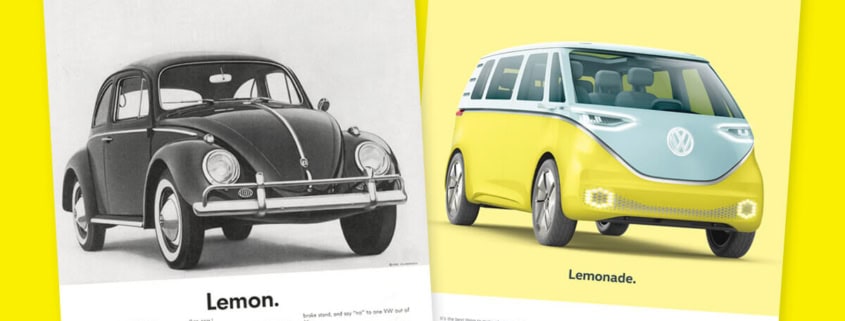
It takes creative intelligence to use AI effectively because some abilities are uniquely human. For example, as one of the most successful advertising campaigns of all time, it was a bold move for Volkswagen to buck conventional wisdom and create something entirely new. The “Think Small” and “Lemon” ads transformed the Beetle into the top-selling foreign car in America. By the time the original car’s production ended, global sales reached over 21.5 million. And it still works 65 years later.

AI can’t do this. However, it can personalize the campaign to millions of individuals simultaneously, track responses, and optimize media spend in real time. But true originality, viral, iconic campaigns, coming up with original ideas, storytelling approaches, or brand narratives are uniquely human abilities. AI can remix existing ideas, but true creativity — especially disruptive or category-defying concepts — comes from human intuition and lateral thinking. And so does crafting user journeys and content that feel intuitive, inclusive, and emotionally relevant.

In marketing communications, despite the rise of AI and automation, there are still many critical functions that only humans perform effectively. These functions typically involve deep empathy, creativity, and strategic thinking in complex environments. While Machines can analyze trends, humans interpret emotional resonance and cultural context in a way that feels authentic and respectful. AI lacks context awareness and can misinterpret information entirely.

AI can’t fake trust, charisma, and interpersonal chemistry. Brand strategy requires synthesizing business goals, cultural insight, and evolving human behavior in ways machines can’t fully model. Inventing new, interactive ways to engage users digitally with breakthrough creative thinking requires curiosity, cross-disciplinary insight, and risk-taking. In 2025, where attention is scarce and sameness is automated, originality is your competitive edge. That’s where we come in.

The difference between innovation and automation is clear: One good communication can make a customer for life.

It is an indisputable fact that innovation drives progress. This was the big realization of nineteenth-century economics, leaving behind forever its fundamental theory that some things were inevitable and unchanging, like poverty. It illuminated education as the driver of upward mobility, something we take for granted today. This epiphany propelled the age of industrialization, then, calling it disruption, the information age, into this fantastic new world we live in.

All of it came down to one thing: an original idea. Originality in humans often springs from purpose or passion—an urge to create, express, solve, rebel, or explore. Marketing has come to rely on automation, but computers and AI don’t have intention or inner drive. They respond when prompted, and only then, because they lack selfhood entirely. Software and AI are developed to model language based on vast patterns of human communication. It can recombine, remix, and recontextualize in ways that feel novel—but every part of its “thinking” process is statistical prediction.

The keyword here is humanity. Every company is a brand. A successful brand is a metaphysical story that connects with people. The concept of Brand Personality was first conceived by the agency Young & Rubicam, where I was a division manager and a creative director. A strong brand personality can be the crucial distinguishing factor that creates preference for your brand and lifetime customer relationships.

It takes innovation, creativity, and experience to tell your story well across all the touchpoints in today’s marketing communication landscape. And a deep, human understanding of technology. AI can simulate innovation, and often convincingly. But a true original idea in the human sense—one that springs from personal experience, conscious curiosity, or emotional risk—is beyond its reach. Only human ideas can change conditions, and the success of any business is a work in progress.

To sustain sales, lead generation and brand identity, creating quality content in all forms is required. If marketers don’t constantly refresh available content, they run the risk of capturing an audience but not having anything relevant to say to them. That’s where we come in.