AI recommends businesses people talk about. Starting the conversation can be easy. Keeping it going is the hard part.

Sustaining business growth is the problem.

A clever video, social post, or campaign just can’t do it. When AI picks someone else, it never shows up in your reports. But it does in your bottom line—gross income is the final test of whether your marketing dollars are working.

In one year, the share of consumers asking AI to recommend a business jumped from 6% to 45% —BrightLocal, 2026. In B2B, 84% of prospects now use ChatGPT, Claude, or Perplexity to find vendors —Wynter, 2026. Buyers ask one question and get a shortlist of names. So what’s the formula behind how AI picks those names?

Mostly from sources outside your website. Across 75,000 brands, how often a brand was mentioned around the web correlated with AI visibility three times more strongly than backlinks did. Mentions on YouTube correlated most strongly of all. Nearly half of ChatGPT’s citations come from third-party listings like Yelp, BBB, and industry directories. In another analysis, half of ChatGPT’s most-cited pages were “bestof” lists. The number of pages on your own site barely registered.

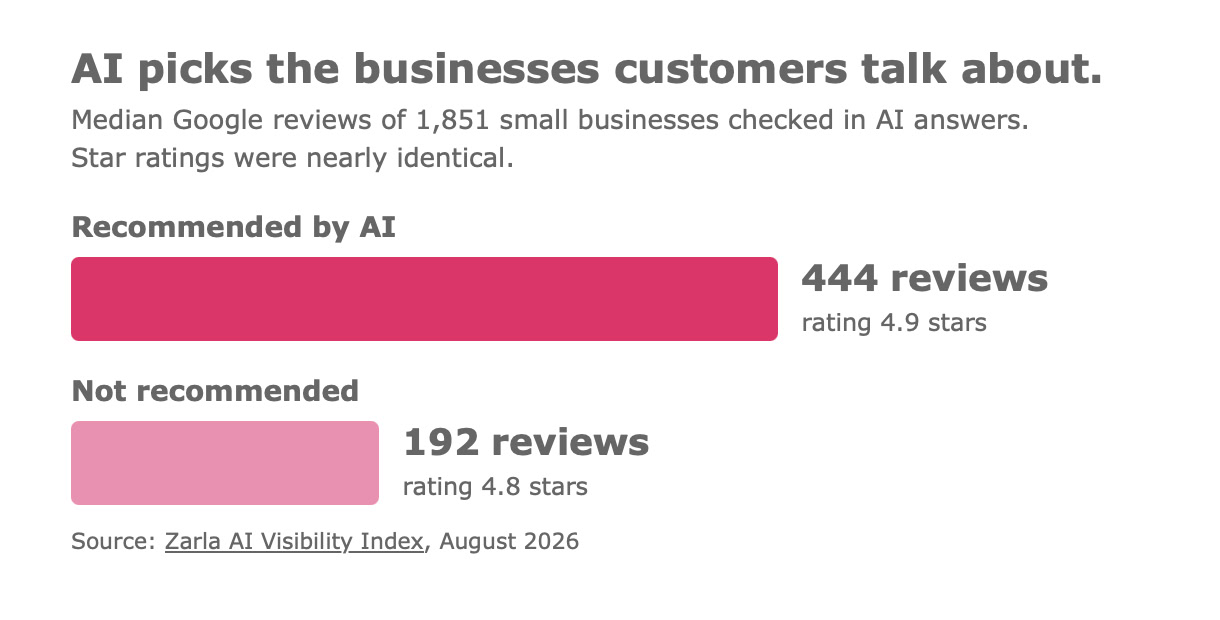
Reviews carry real weight too. In an August 2026 study of 1,851 businesses, the ones AI recommended had a median of 444 Google reviews. The ones it skipped had 192, and star ratings were nearly identical—Zarla, 2026. And 97% of buyers check AI’s answer against real reviews before choosing —BrightLocal, 2026.

*****
Zara AI Visibility

The bottom line.

AI drives traffic to the businesses people talk about: customers in reviews, publications and “best of” lists, video, social media and directories. That doesn’t come from SEO. When campaigns air, searches for the brand inside AI tools rise in the following weeks, and the brand’s story carries into AI’s answers —BrightEdge, 2026. But that doesn’t continue; when the campaign spending ends, so do the AI searches.

However, AI also rewards something we understand. Google’s quality guidelines favor experience, expertise, authority, and trust, and AI tools lean on the same signals. That’s brand positioning and a clear USP well told: one authentic voice across your ads, website, listings, email, social, and customer reviews. Scattered messages read as noise to buyers and machines alike. This defines an integrated digital marketing ecosystem.
Marketing Funnel

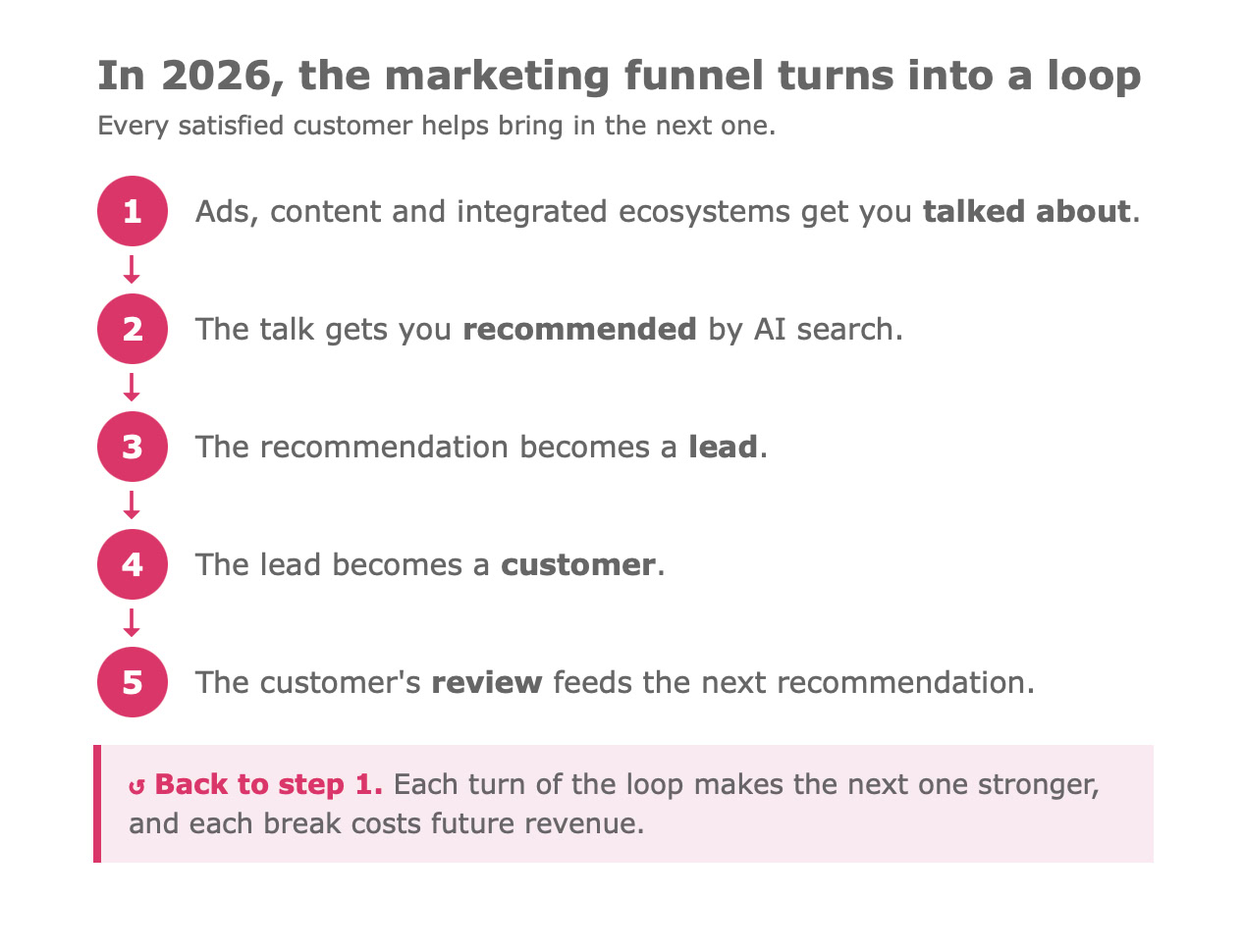
Your next customer’s AI recommendation is written by your last customer.

And that customer’s experience depends on your end-to-end digital ecosystem.

Every break in that loop costs future revenue, and most happen out of sight: a campaign nobody remembers, a listing that doesn’t match your website, a customer who’s never asked for a review, an AI-referred buyer left waiting. Only 27% of B2B leads get a reply within an hour, yet leads answered within five minutes qualify at 21 times the rate —Visionary Marketing, 2026.

Your reports won’t show it. When AI recommends a competitor, there’s no lost click to track. When it recommends you, buyers type your name or call, and the credit goes to “direct” traffic. Email reports add noise too: in one test, 71% of clicks came from security bots, not people —KP Playbook.

That’s why GEO alone won’t get you recommended. Your next customer’s AI recommendation is written by your last customer. And that customer’s experience depends on your end-to-end digital ecosystem.

Every break in that loop costs future revenue, and most happen out of sight: a campaign nobody remembers, a listing that doesn’t match your website, a customer who’s never asked for a review, an AI-referred buyer left waiting. Only 27% of B2B leads get a reply within an hour, yet leads answered within five minutes qualify at 21 times the rate —Visionary Marketing, 2026.

Your reports won’t show it. When AI recommends a competitor, there’s no lost click to track. When it recommends you, buyers type your name or call, and the credit goes to “direct” traffic. Email reports add noise too: in one test, 71% of clicks came from security bots, not people —KP Playbook.

That’s why GEO alone won’t get you recommended.

The fix isn’t a tactic. It’s a connected system.

AI rewards businesses whose brand, reputation, website, digital marketing ecosystem, and follow-up all tell the same story.
It’s exactly the situation BLAIRCOMM has been built to solve:

  • Branding and positioning that clearly define who you are and who you serve best, so buyers and AI describe you correctly.
  • Creative and content written for the way people now ask AI questions, not just for keywords.
  • Web development: fast, structured, mobile-first sites that AI can read and that convert buyers who arrive ready to decide.
  • Listings and reputation: consistent profiles everywhere, with automated review requests after every sale.
  • Direct response: PPC, programmatic, and social that send qualified prospects to your sales team, store, or website.
  • Automation and integration that connect your website, CRM, email, and sales team into one customer journey, so every lead gets answered in minutes.
  • Analytics and attribution that trace AI’s hidden influence and engagement with the bots filtered out, all the way to the sale.

This is how a homebuilder client sold 500+ homes in a single year. It came from a system built for steady flow, not from one big campaign.

Try this today: Ask ChatGPT to recommend a company like yours in your market. If it doesn’t name you, you’re losing business and revenue that will never show up in a report.

Vintage Virtual Googles

AI is rewriting marketing rules for 2027 with technology from 1912. Here’s how you can win anyway.

Going into 2027, one thing is driving the drop in web traffic, clicks, and new business: AI now filters results and answers before a human ever reaches a website, an inbox, or an ad. This means buyers are making more and more decisions without leaving a click or any evidence you can track. For about 20 years, SEO tactics let ordinary brands buy visibility without having a distinctive message. AI is now closing that gap.

Companies whose story is true, distinctive, and consistent across every channel are the ones getting business. A patchwork of vendors can’t deliver that, because no one owns the whole story. New technology now applies the 1912 advertising maxim of  H. K. McCann, “Truth Well Told” as a filter. And fragmentation is the real reason brands are losing. When search, email, ads, creative, and data sit with separate partners, AI gatekeepers expose the gaps.

The fundamentals now decide who AI recommends.

The idea is simple: effective marketing to succeed must find a genuine, relatable truth about people or a product and tell it in a compelling way. Today, it also has to be told the same way everywhere, which is impossible with in-house teams plus multiple vendors each pushing their own version.

Google says the same thing in its own words. Its 2026 guide to AI Overviews and AI Mode tells businesses to create “non-commodity content”: specific, experience-based work that goes beyond common knowledge. A generic article that anyone could have written gets summarized away. A distinctive point of view gets cited.

— Google Search Central


“Brands that tell one clear, credible story get named.

Brands split across disconnected vendors disappear.”


Here’s where fragmentation is costing businesses in 2026:

Search Chart


You don’t need more partners, just the right partner.

BLAIRCOMM provides a single resource that can seamlessly integrate leading-edge strategy, creative, digital marketing, automation, and reporting into a company’s operations. We offer a real solution to talent gaps, tight budgets, skill shortages, and unrelenting demands for measurable impact. In a free consultation, we’ll evaluate your current digital marketing ecosystem, uncover your most critical growth gaps, and outline a strategy. Serious about predictable growth? Let’s start now.


The Costly Marketing Mistake That Doesn’t Look Like One.

Right Problem, Wrong Solution.

If new customers stopped tomorrow- none for 90 days- what happens to your revenue? For some companies, not much. A multinational brand with deep pockets, or a financial firm past a certain scale that grows on its assets. A business that just closed one large deal can coast on it for a while. They can afford a slow quarter.

But for most companies, the answer is closer to everything stops. Revenue is a direct function of how many new customers show up this month, and the next, and the one after that: homes sold, sales delivered, contracts signed, subscriptions renewed, deals closed. There’s no asset quietly compounding in the background. The pipeline is the business.

There’s a pattern hiding in plain sight across every industry we work in, a marketing mistake quietly costing income and future growth, one nobody’s naming. A homebuilder doesn’t think of itself as having the same core problem as a law firm, a SaaS company, a hotel, or a motorcycle manufacturer. Different products, different buyers, different sales funnels — surely different problems.

They’re not. Strip away the industry, and it’s the same structural issue: a business that needs a continual stream of new or repeat customers to survive is fundamentally different from one that doesn’t — and it needs to be marketed differently. But most of these companies are still marketing like they’re the exception. They run a campaign, get a bump, watch it fade, then start over, as if a burst of attention were the goal, instead of a steady, compounding flow of demand. That’s a mismatch.

A continuous growth engine doesn’t come from campaigns only.

A business that needs continuous customers shouldn’t rely on a marketing model built for episodic attention. We’ve seen this hold across every vertical we work in. A homebuilder client sold 500+ homes in a single year, not from one big campaign, but from a system engineered for continual flow: website, PPC, programmatic, social, geo-targeted demand that outperformed Zillow on sales office traffic, sustained rather than spiked. All funneling prospects to their sales managers 24/7.

Here’s where most companies get the prescription wrong. They recognize they need continuous, not episodic, marketing, then produce it the same fragmented way they’d hire a one-off campaign: a freelancer for content, a different shop for paid media, a separate team for the website, a large agency for “strategy” that hands the week-to-week work to a junior account team once the contract is signed. That’s not a solution. It’s the same problem in disguise.

A pipeline that can’t afford to go quiet needs one partner, accountable end to end — creative, media, web, and automation working as a single, integrated system, not four vendors hoping to stay in sync. And it needs senior judgment on the account every day, not just at the pitch meeting. Retaining a large agency often means paying for senior-level overhead and getting junior-level execution. We built BLAIRCOMM as the alternative: full-stack, one partner, senior talent on your account, without the overhead that usually comes with that level of experience.

If your revenue depends on customers who haven’t shown up yet, the question isn’t “what’s our next campaign?” It’s whether you have one infrastructure built for continuous flow — or four vendors and a junior team pretending to be one.

Want a 15-minute look at what an always-on ecosystem would look like for your team? Contact Michael Blair now, or click the button to schedule a quick Zoom meeting:

Digital marketing is a work in progress.

Digital marketing is a work in progress if you want to succeed. A commitment. Your message must be far more compelling than the 8,000 others from 10 million competitors a person sees daily. You must navigate convoluted behemoths like Google whose very existence depends on getting more of your money. And, you must get a huge market’s agreement to consider your company one person at a time. Technology is only a single piece of this strategy, but communication is the key to engineering consent and only humans can create and communicate.

A business website is like Shakespeare written in code. It must speak to human needs. It must not just convince, but persuade. It must be your company’s frontline marketing communication and position your enterprise against 100 million competitors. It must be developed and maintained with many leading-edge technologies that no one person is a master of. And, it must deliver an unreasonable return on investment to earn its place as a valuable business asset.

Marketing automation is strategic insight transformed into reality. First, you must master the many breakout technologies that drive leads, convert them to sales, and optimize marketing ROI with complex analytics. You must program intricate automated systems that integrate with websites and custom CRMs for promotional, social, and sales management. And, to compete, you must have world-class creative capabilities for messaging and content development across devices and platforms. All within budget. Automation is only as good as the people behind it.

Engagement marketing is the flip side of interruption marketing. Done right, it changes everything. To begin, you must be clear about what unique value you own and its benefits. You must understand the interests of individuals in a vast, anonymous market and speak well at exactly the right moment. You must earn people’s attention, but can’t reliably demand it anymore. You must curate content far above all your competitors to nurture savvy prospects up the permission ladder from strangers to friends to loyal customers. Technology is a vital tool, but only people can bring about understanding to influence others.

If you’re already number one, just ignore us. We’re looking for number two. Companies that need to compete need us. We are a small office with big capabilities. We help clients develop integrated and digital marketing communications to reach and influence individuals in their target markets across rapidly changing media and devices. Our creative is award-winning. Our technology is leading-edge. Our overhead is low, and that means greater profit for our clients. We are the nexus that makes technology and humanity work together.